Key Takeaways
- Scenario-Driven Selection: High-frequency door operation exposes hardware to repeated mechanical stress and environmental corrosion; material selection must be driven by traffic volume and corrosion class rather than aesthetics alone.
- Substrate Compatibility: When pairing hardware with a solid wood door or high-end wooden door lines like the Bionic Wood Veneer Series, aesthetic consistency and galvanic compatibility are critical to prevent structural decay [K1][K4].
- Sizing and Load Matching: Verified product specifications (e.g., carbon crystal board, 920×2250 mm panels) dictate the necessary hinge load rating and finish coordination [K2][K3][K5].
- Standardized Performance: Specifying hardware using EN 1670 corrosion classes and ASTM B117 neutral salt spray hours provides a measurable benchmark for durability.
- System Quality Baseline: Project teams should align co-specified hardware quality with the governance and release standards (reviewed, medium risk) of the primary door series [K1][K4].
1. Introduction
In both residential and commercial construction, doors and windows are among the most active building components. An entry door in a busy commercial office, a co-living apartment block, or a coastal residential villa may experience hundreds of cycles per week. While significant attention is typically dedicated to the door leaf—whether a traditional high-density solid wood door or a modern high-end paint-free engineered door—the supporting hardware (hinges, locks, handles, and pivots) is what ultimately determines the assembly’s safety, acoustic performance, and visual appeal over its lifecycle.
Common failure points are well-known to facility managers and homeowners: orange rust streaks staining the door face, squeaking or binding hinges, and lock cylinders that fail after a few years of high-frequency operation. As the market shifts toward custom, light-luxury interior design, door systems have become more integrated. For example, Fedars’ architectural bionic wood veneer door collections are positioned as a line of “high-end paint-free wooden doors and same-color aluminum wood doors,” utilizing carbon crystal board substrates and synchronized moulding craft [K1][K4]. Standard manuals specify standard dimensions such as 920×2250 mm, with distinct finishes like D10 Peach Wood No.1, D22 Snow Mountain Elm, and D02 Golden Walnut [K2][K3][K5].
While the door leaves themselves feature advanced environmental and structural governance (reviewed, medium risk status) [K1][K4], the longevity of the entire entrance system depends on the selection of adjacent hardware. This guide provides an answer-oriented framework for specifying door and window hardware materials for high-frequency use, ensuring mechanical durability and electrochemical compatibility.
2. High-Frequency Use Scenarios and Environmental Classification
Core Principle: Expected traffic volume and environmental exposure must serve as the primary filters for hardware specifications. Vague “rust-proof” marketing claims are insufficient for long-term compliance.
The Mechanism of Failure
Corrosion begins at microscopic defects in protective platings or anodized layers. In high-frequency scenarios, repeated friction from opening and closing wears down these protective barriers. Once the base metal is exposed to humidity, hand oils, or airborne chlorides, galvanic oxidation accelerates. Furthermore, mechanical wear from high cycle counts can loosen fixings, causing the door leaf to sag and increasing the torque on the upper hinges.
Environmental Classes
Under the European Standard EN 1670, corrosion resistance is classified into five distinct grades:
- Grade 1 (Mild): Indoor dry environments.
- Grade 2 (Moderate): Indoor environments where condensation may occur.
- Grade 3 (High): Wet indoor or outdoor environments.
- Grade 4 (Very High): Severe outdoor environments (e.g., industrial or urban exterior).
- Grade 5 (Exceptionally High): Marine and highly polluted atmospheres.
Practical Application: Consider a heavy solid wood door installed at the main entrance of a coastal resort. While the door leaf is factory-sealed, standard zinc-plated steel hinges will develop pitting and orange rust within two coastal seasons. This rust not only damages the wood grain but also risks hinge binding and failure. Similarly, for a lighter panel like the Bionic Wood Veneer Series (carbon crystal board, 920×2250 mm) [K2][K3], failing to specify corrosion-resistant hinges will lead to rust stains bleeding onto the lower edge of the door leaf.
Actionable Recommendation: Project teams must document the estimated daily cycle count and the EN 1670 environmental class before finalizing hardware finishes. Request laboratory evidence of salt-spray performance rather than relying on visual samples.
3. Material Options for Durable, Corrosion-Resistant Hardware
Core Principle: Stainless steel alloys, copper-based brass, and anodized aluminum are the three pillars of premium hardware; each has specific mechanical and chemical boundaries.
304 vs. 316 Stainless Steel
Stainless steel is the industry standard for strength and corrosion resistance. However, the alloy grade must match the exposure:
- Grade 304 (18/8): Contains chromium and nickel. It offers excellent durability for interior high-humidity areas (bathrooms, kitchens) and standard urban exteriors.
- Grade 316 (Marine Grade): Adds 2-3% molybdenum. This composition prevents pitting corrosion from chlorides (salt spray, chlorine in indoor pools). It is mandatory for marine climates and industrial facilities.
Brass and Bronze
Solid brass (an alloy of copper and zinc) is naturally resistant to corrosion and possesses antimicrobial properties, making it excellent for high-touch public areas. It provides a classic, heavy feel suited for high-end traditional solid wood doors. However, brass is susceptible to dezincification in humid, acidic, or saline environments if not treated with a high-durability clear lacquer or periodic wax coatings.
Anodized Aluminum
Anodization thickens the natural oxide layer on aluminum, creating a hard, wear-resistant, and non-conductive surface. It is highly resistant to atmospheric corrosion and can be dyed in various metallic tones. This aligns perfectly with the “same-color aluminum wood door” framework of the Bionic Wood Veneer Series [K1][K4].
[建议补充:此处建议提供不同材料在 ASTM B117 中性盐雾测试下的具体耐久时数对比,如 316 不锈钢可达 1000 小时,而普通镀锌钢仅为 96 小时。]
Actionable Recommendation: For luxury wooden doors (such as the D10 Peach Wood No.1 or D22 Snow Mountain Elm finishes) [K2][K3], select a hardware finish that matches the designer’s intent. For heavier solid wood leaves, prioritize the mechanical load rating of 304/316 stainless steel or solid brass. For modern, flush, paint-free doors, anodized aluminum concealed hinges provide the necessary clean lines and low weight.
4. Hardware and Substrate Compatibility: Preventing Galvanic Corrosion
Core Principle: The electrochemical interface between the hardware, fasteners, and door leaf must be managed to prevent accelerated decay.
The Risk of Galvanic Corrosion
When two dissimilar metals (such as carbon steel fasteners and an aluminum door frame) come into contact in the presence of an electrolyte (moisture), they form a galvanic cell. The less noble metal (the anode) corrodes at an accelerated rate.
In custom door installations where an aluminum-wood composite frame is specified (such as the Bionic Wood Veneer Series [K1][K4]), selecting the wrong fastener material can lead to rapid deterioration of the frame casing around the screw holes, causing the door to loosen.
Mechanical Integration with Wood
Traditional solid wood doors experience dimensional changes due to seasonal shifts in humidity. Hardware specified for solid wood must allow for slight adjustments (e.g., 3D adjustable hinges) and feature deeper screw threads to grip the natural wood fibers securely.
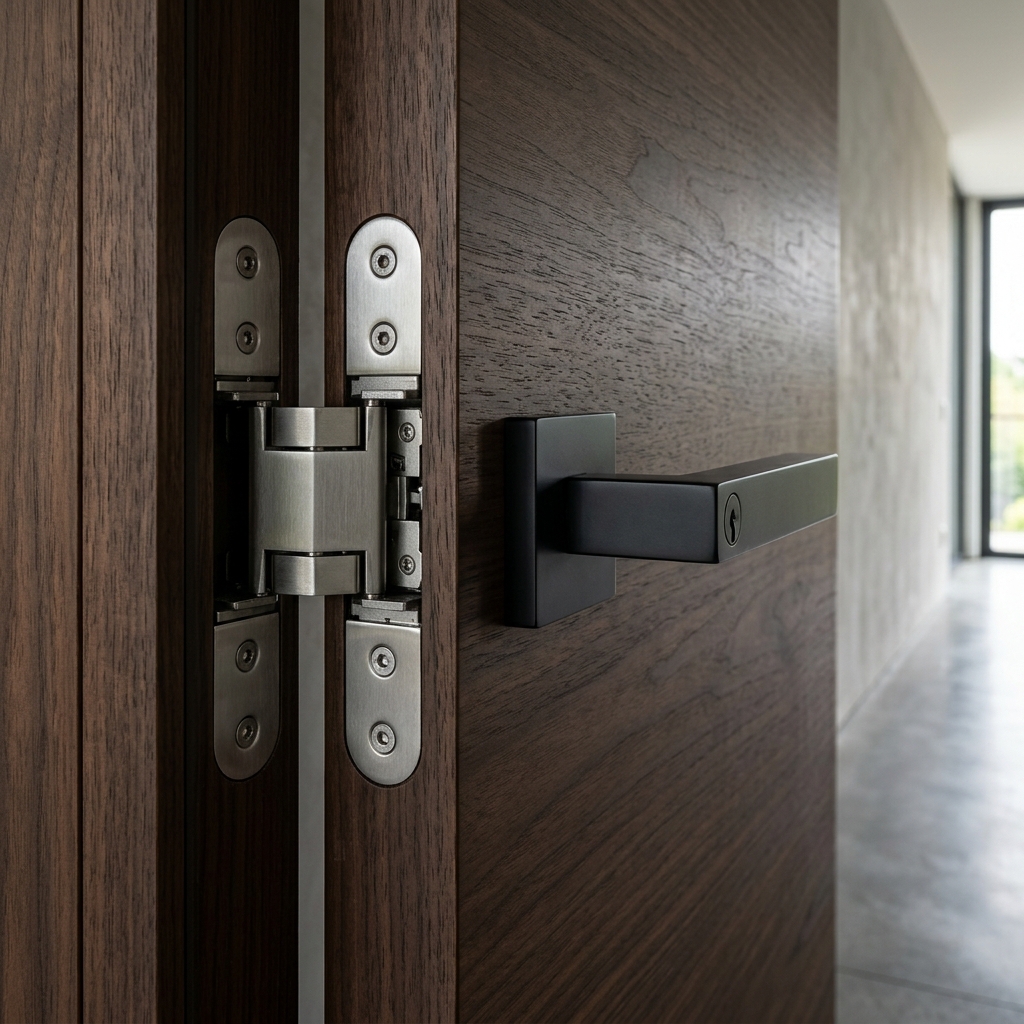
In contrast, engineered boards like the carbon crystal board panels in the Bionic Wood Veneer Series (920×2250 mm) [K2][K3] are highly stable and do not warp, but they require high-precision, factory-machined CNC hardware slots to distribute the load evenly across the composite core.
| Hinge Type | Best Leaf Substrate | Adjustability | Typical Corrosion Rating | Recommended Fastener Material |
|---|---|---|---|---|
| Concealed 3D Hinge | Carbon Crystal / Engineered Board | 3-Way (X, Y, Z Axis) | EN 1670 Grade 4 (Anodized Al) | Grade 304 Stainless Steel |
| Heavy-Duty Butt Hinge | Heavy Solid Wood Door | None (Shim required) | EN 1670 Grade 5 (316 Stainless) | Grade 316 Stainless Steel |
| Concealed Pivot Hinge | Wide / Overheight Panels (e.g., 3050mm) | Height & Alignment | EN 1670 Grade 3 (Coated Steel) | High-Tensile Steel (zinc coated) |
Actionable Recommendation: Always specify stainless steel screws (Grade 304 or 316) for installing hardware on both solid wood and composite doors. If aluminum components must interface with steel or copper alloys, insert non-conductive nylon washers or isolation gaskets to break the electrical connection.
5. Technical Specifications and Hinge Sizing Matrix
To ensure the hardware can support the weight of the door leaf over hundreds of thousands of cycles without sagging, refer to the sizing and colorway coordination matrix below. This matrix pairs standard door specifications from the Bionic Wood Veneer Series with the appropriate hardware profiles.
| Door Finish Code & Model | Base Material | Panel Dimensions | Hinge Weight Capacity Required | Target Hardware Finish Tone | Evidence Source |
|---|---|---|---|---|---|
| D10 Peach Wood No.1 (YQ-26) | Carbon Crystal Board | 920×2250 mm | Min. 60 kg (2 Hinges) | Matte Champagne Gold / Bronze | [K2] |
| D22 Snow Mountain Elm (YQ-07) | Carbon Crystal Board | 920×2250 mm (up to 3050 mm) | Min. 80 kg (3 Hinges for overheight) | Satin Chrome / Anodized Silver | [K3] |
| D02 Golden Walnut (YQ-52/55) | Carbon Crystal Board | 920×2250 mm | Min. 60 kg (2 Hinges) | Antique Brass / Matte Black | [K5] |
| Solid Wood Door (Generic) | Solid Hardwood (Oak/Walnut) | Custom (Variable) | Min. 100 kg (3 Heavy Butt Hinges) | Oil-Rubbed Bronze / Satin Stainless | Industry Std |
Hardware Specification Checklist:
- Determine the Corrosion Class: Match the project site to EN 1670 Grades 1 to 5.
- Verify Cycle Durability: Insist on BS EN 1935 Grade 11 (200,000 cycles) or Grade 12 (200,000 cycles, heavy duty) certifications for high-frequency public doors.
- Perform Weight Calculations: Calculate the combined weight of the door leaf and glass inserts; select hinges rated with a safety factor of 1.3.
- Confirm Galvanic Safety: Ensure all fasteners are stainless steel, and use isolation barriers when mounting aluminum-alloy hardware.
- Aesthetic Alignment: Coordinate hardware finishes with the designated door colorway (D10, D22, D02) to preserve the design scheme [K2][K3][K5].
6. Frequently Asked Questions
Q1. Why does my solid wood door squeak, and will the same happen with carbon crystal board doors?
Squeaking in solid wood doors is typically caused by friction in unlubricated hinge pins, which is exacerbated when the heavy wood leaf expands seasonally and increases structural load on the hinges. Carbon crystal board panels (such as the Bionic Wood Veneer Series [K2][K3]) do not warp or expand with humidity, but squeaking can still occur if the hinges lack maintenance. Using hinges with maintenance-free nylon or polymer bearings eliminates this issue.
Q2. Can I use standard interior-grade brass handles on an exterior door?
No. Standard interior brass handles are usually coated with a thin lacquer intended only for dry indoor environments (EN 1670 Grade 1 or 2). Exposed to rain, UV light, and temperature changes, this lacquer will crack and peel, leading to tarnishing and dezincification. For exterior doors, specify Grade 316 stainless steel or solid bronze with an oil-rubbed living finish.
Q3. What is the Bionic Wood Veneer Series, and how does it affect hardware installation?
The Bionic Wood Veneer Series consists of high-end paint-free doors made of stable carbon crystal board and synchronous moulding [K1][K4]. Because these doors use a dense composite core rather than solid timber, hardware cannot be randomly screwed on-site. The hinges and locksets must be pre-machined at the factory using precision CNC equipment via Fedars’ factory pre-hung and CNC pre-machining services to ensure structural integrity and maintain the manufacturer’s warranty.
7. Conclusion
Achieving long-term durability in high-frequency door and window assemblies requires matching the hardware material to the environment and the door substrate. A traditional solid wood door and a modern engineered composite like the Bionic Wood Veneer Series [K1][K4] both require deliberate technical specifications. Using generic, off-the-shelf hardware risks premature failure, squeaking, and aesthetic decline.
For optimal performance, project specifiers should calculate exact door weights (920×2250 mm standard or 3050 mm overheight) [K2][K3][K5] and verify the EN 1670 corrosion grade of all metal parts. Request physical sample sets to verify color compatibility with the door finish (such as D10, D22, or D02) before purchasing in bulk.
High-Frequency Architectural Door & Hardware Specification
- Architectural Doors: Explore Fedars’ engineered timber and bionic veneer door collections.
- Whole-House Joinery: Coordinate matching bespoke cabinetry and architectural wall cladding.
- Factory CNC Integration: Learn about our pre-hung casing and factory CNC ironmongery mortising services.
- Inquiries & Samples: Request physical veneer samples, hardware schedules, or project quotations.
Last Updated: 2026-07-15
Evidence Provenance: Door substrate dimensions, materials, and finish codes (D10 Peach Wood, D22 Snow Mountain Elm, D02 Golden Walnut) verified against the Bionic Wood Veneer Series technical manuals [K1][K2][K3][K4][K5]. Hinge mechanical classifications and corrosion testing guidelines aligned with BS EN 1935 (single axis hinges) and EN 1670 (corrosion resistance) standards.